
Driving down a straight, open stretch of asphalt should require little more than a relaxed hand resting on the wheel. When a vehicle behaves properly, its chassis tracks true, absorbing minor road undulations without attempting to wander off course. Yet countless drivers find themselves in an exhausting physical tug-of-war with their steering rack, forced to apply constant leftward pressure just to keep the car centered in its lane. Release the wheel for even two seconds, and the front end promptly creeps toward the right shoulder.
While the natural inclination is to blame a simple alignment error, tracking issues are rarely one-dimensional. A pronounced pull can stem from minute geometric imbalances within the steering linkage, civil engineering choices made during road construction, or mechanical drag hiding inside a brake caliper. Diagnosing the issue accurately requires understanding how your suspension geometry interacts with the road beneath it.
The Big Three: Camber, Caster, and Directional Pull
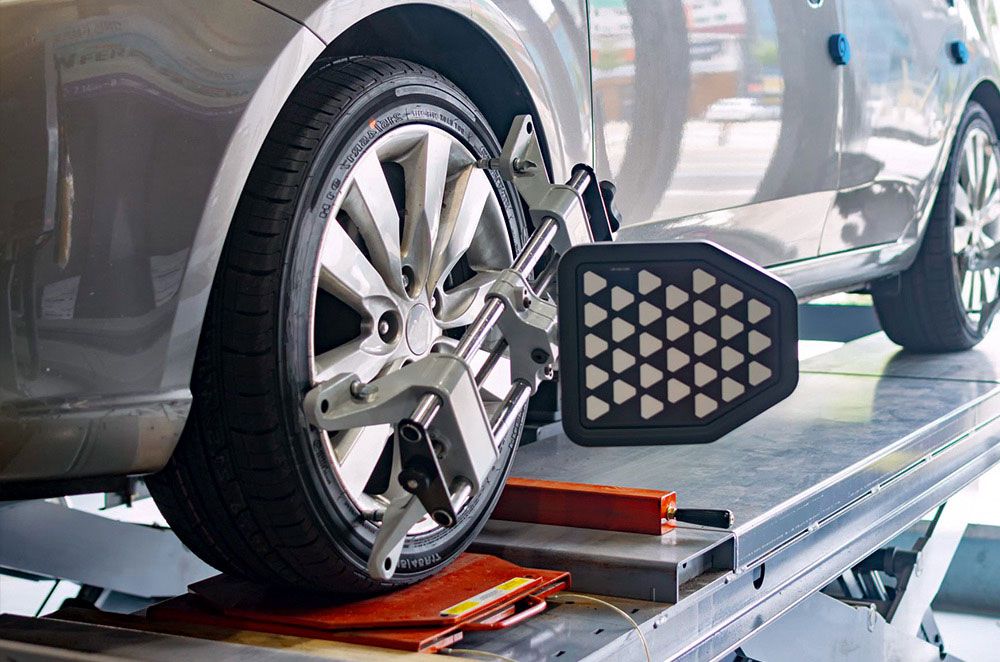
When an automotive technician mounts computerized targets to your wheels, they evaluate three primary measurements: camber, caster, and toe. Each controls a specific plane of movement, but they influence vehicle behavior in drastically different ways.
Camber and Lateral Lean
Camber refers to the inward or outward tilt of the tire when viewed directly from the front of the vehicle. If the top of the tire leans away from the engine bay, the wheel has positive camber; if it tucks inward toward the fender liner, it has negative camber.
Tires naturally generate a lateral force toward the side with more positive camber, a phenomenon known as camber thrust. If your left front wheel sits at zero degrees while the right front wheel sits at one degree of positive camber, the vehicle will pull toward the right. Uneven camber not only introduces a continuous directional bias but also rapidly chews through the outer or inner edges of your tire tread.
Caster and the Pivot Axis
Caster describes the forward or backward angle of the steering pivot axis when viewed from the side of the vehicle. Picture the front wheels of a grocery cart: the pivot point sits slightly ahead of the wheel contact patch, forcing the wheel to follow along behind it in a straight line. In an automobile, positive caster tilts the steering axis backward toward the cabin.
Positive caster is what provides high-speed directional stability and forces the steering wheel to return to center automatically after you complete a turn. When caster angles are unequal from side to side—a condition known as cross-caster—the vehicle will pull toward the side with less positive caster. If a severe pothole knocks your right front strut backward, reducing its positive caster relative to the left side, the car will consistently wander to the right.
The Role of Toe
Toe indicates whether the tires point inward toward each other or outward away from each other when viewed from bird’s-eye perspective. While improper toe settings cause rapid, feather-edged tire wear and cause the steering wheel to sit off-center, toe rarely causes a hard pull to one side on its own. Instead, incorrect toe makes the front end feel nervous, skittish, or hyper-sensitive to steering inputs.
The Road Crown Effect: Intentional Civil Engineering
Before assuming a mechanical defect has compromised your vehicle, consider the driving surface itself. Civil engineers do not build roads perfectly flat. Highway lanes and municipal streets are intentionally graded with a subtle downward slope—typically between one and two percent—running from the center line down toward the outer curb. This design, called road crown, prevents standing water from accumulating during heavy rainstorms.
Because gravity acts on the vehicle mass across this lateral incline, every car naturally experiences a gentle drift toward the right on a standard crowned road. A true alignment pull behaves differently than road crown drift.
To tell the difference, find a safe, empty multi-lane highway or a flat secondary road. If you shift into the far left lane on a divided highway—where the crown slopes downward toward the left median—a properly aligned vehicle should drift gently to the left. If the car still fights your hands and insists on drifting right despite the road sloping left, your suspension or running gear is fighting an active mechanical imbalance.
To accommodate regional road crowning, experienced alignment technicians often calibrate a deliberate cross-caster split into the vehicle. By setting the right front wheel with slightly more positive caster than the left—often between a quarter and a half of a degree—the vehicle develops a subtle leftward bias that effectively cancels out the natural downward pitch of the roadway.
Tire Dynamics: Conicity and Rolling Resistance
The steering system responds to forces generated at the contact patch where rubber meets pavement. Even when your suspension geometry matches factory specifications down to the tenth of a degree, irregularities within the tires themselves can mimic severe alignment errors.
A tire underinflated by as little as five or six pounds per square inch exhibits significantly greater rolling resistance than its properly inflated counterpart. If the front right tire runs low on air, it acts as a mild anchor, dragging the vehicle toward that side.
A more elusive culprit is tire conicity, also known as radial pull. During manufacturing, the internal steel belts of a tire can occasionally cure slightly off-center, or uneven tread wear can shave the tire into a microscopic cone shape rather than a true cylinder. Because a cone naturally rolls in a circle rather than a straight line, a conical tire exerts constant lateral force against the road.
Technicians diagnose radial pull through a straightforward process of elimination: they swap the front left and front right tires. If the vehicle was pulling to the right and immediately begins pulling to the left after the swap, the suspension geometry is sound; the tire carcass itself is defective or unevenly worn.
Mechanical Drag and Suspension Fatigue
When alignment angles and tires check out, the search shifts to the mechanical hardware responsible for braking and wheel articulation.
A seized brake caliper slider pin or a collapsing flexible rubber brake line can prevent the brake pads on the front right wheel from retracting fully after you release the pedal. The continuous friction creates localized heat, reduces fuel economy, and exerts a relentless rightward tug. You can often spot brake drag by checking for excessive black brake dust on the right wheel or noticing a distinct burning odor after highway driving.
Similarly, worn lower control arm bushings, loose ball joints, or fatigued tie rod ends can throw off your vehicle’s alignment under real-world driving conditions. On an alignment rack, an unloaded suspension might register acceptable static angles. Yet once the vehicle accelerates or encounters road friction, the play within worn rubber bushings allows the control arm to shift out of position, destabilizing dynamic alignment and producing an erratic pull.
Addressing a persistent pull promptly protects your wallet as much as your safety. Fighting a drifting steering rack accelerates tire wear, stresses internal steering gear, and causes premature driver fatigue. By having a qualified technician evaluate your tire pressures, inspect suspension bushings for play, and provide a comprehensive four-wheel alignment printout, you restore the effortless, centered stability your car was engineered to deliver.